Calculus II
Find the hydrostatic force on one side of the plate
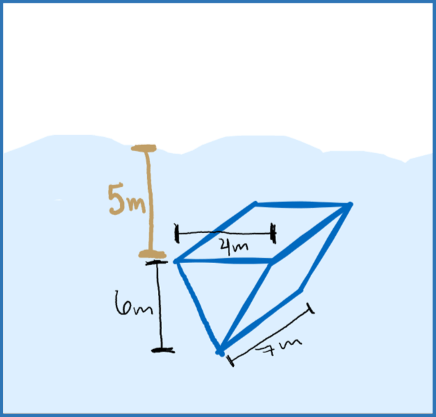
Imagine you submerge a box in water. Water is pressing in on all sides of the box. How much force does the water exert on one (vertical) side of the box?
Summary

Background Knowledge
what tools do you need to solve this problem?
- F = PA
- (Force = Pressure * Area)
- (why does this make sense? what is pressure? if you push your hand down on a table, does it make sense that the pressure on the table is the force you push down divided by the area on which you’re pushing? So pressure = force / area)
- P = ρgh
- (Pressure = density of water (ρ) * acceleration due to gravity (g) * depth of object in water (h))
- ρ is the Greek letter “rho” (pronounced “row”) and at some point someone decided it should mean density. The density of water is 1000 kg/m3
- g, the acceleration due to gravity, is 9.8 m/s2
- If we are using Imperial units instead of metric, ρg is combined into one measurement, called the “weight density of water” (because gravity is included in weight). In Imperial units, ρg = 62.4 lb/ft3
- Sometimes mathematicians use d for depth instead of h. Physicists usually prefer h. I’ll use h here, but just know that sometimes you might see it as a d.
- Fact: Pressure increases as you increase in depth, but stays the same at each horizontal layer.
- Notice that we are looking for Force, so if we combine the two above equations, we get:
F = ρghA
- And our constants are:
ρ = 1000 kg/m3
g = 9.8 m/s2
Or ρg = 62.4 lb/ft3
Solving the Problem
Always, the first thing we need to do is DRAW A PICTURE. Make sure you draw a picture of the “plate” (one side of the box) on your paper before you do anything else.

The next thing we need to do is to put our plate on a graph.

So draw an origin and some axes on the plate.
You can always put the origin wherever you want, as long as you are consistent throughout the problem. For most shapes it’s easiest to put the origin at the bottom center. For circles it’s easiest to put the origin in the center of the circle.

Now we need to slice our plate into little pieces.
Why did we have to slice this up?

Remember that the pressure changes as we go down into the water. So not all parts of the plate have the same pressure (and therefore, force) on them. We slice up the plate so we can find the force on a single slice. A single slice will be infinitesimally thin so we can say the force is the same everywhere on that little slice.
Why did we slice horizontally? Could we have sliced vertically?

Remember that pressure increases as we go down, but is the same at a single depth. If we had sliced vertically, we still would have had areas of a slice experiencing different pressures than other areas. But when we slice horizontally, we have the same pressure across the whole slice.
Let’s draw one slice to the side and think about how we can find the force on this one slice.
F(one slice) = ρgh(slice)A(slice)
ρ and g are constants, so what are h and A?

Area: The width of the slice is dy, and the length of the slice is 2x.
So A = 2xdy

Depth: The depth is the distance from the top of the water to our slice. In this case, it is a y-value, going from the y-value of our slice to the line y = 11.
So h = 11 – y
How did I know the length of a slice is 2x?
If you only look at the right half of the slice, you can see that the length of that rectangle would be an x-value (because it’s a horizontal distance). Specifically, the distance from x = 0 to the x-value of the edge of the triangle. So the distance is (x – 0) , or just plain x. (We don’t want to put a specific number for that x-value because it’s going to be different for each slice, so we leave it as x instead of trying to figure out how long the exact distance is for our slice.) But that’s only the right half of the slice. To get both halves, we multiply x by 2. So the side length of the whole slice is 2x.
How did I figure out the depth?
The depth is a y-value, because it is a vertical distance. Specifically, it is the distance from the top of the water to our slice. But where is our slice? Well, our slice is located at y meters above 0, so it’s vertical location is just “y”. We don’t want a specific y-value here because each slice will be at a different height above 0. And notice that if we look on the slant of the triangle, that x and y value could be a point on the line of the triangle’s slant! And the top of the water is at y = 11. So the distance between the top of the water and our slice is 11 – y.
So the force on one slice is ρg(2xdy)(11 – y)!
Is it okay to mix x and y values like that? YES! We are setting up a meaningful problem, and each piece has meaning to us. So it’s totally okay to set up the problem with x and y values all mixed together. What is x? It represents half of a side length. What is y? It represent how high up on the plate we are. So we multiply them together because they mean something separately, and they also mean something together. That’s what x and y are for — representing values that we don’t want to put in the exact number for.
Now, this is Calculus, so it’s time to add up all of those little slices! That will give us the total force across the whole plate.
Remember that integration just means adding up the pieces, and that the integral sign just means the “sum” of all the pieces inside of it.


All right, all that’s left is to actually take the integral! That’ll give us the total force on the plate caused by the water.
Just one little problem — it was good for us to set up the integral with both x’s and y’s in it, but we can’t integrate when there are two variables. So now we will need to convert one to the other.
The “dy” or “dx” is always in charge. So since this problem has a dy, we will need to both make certain our bounds are y-values and transform the x into something with y‘s in it.
Luckily for us, this is why we made a graph at the very beginning! Since we made a graph, we should be able to find a relationship between the x-values and y-values of our slices.

In this problem, we got x = y⁄3.
The big difference between hydrostatic force problems isn’t the set-up. You can use this exact same process to set up every hydrostatic force problem you will ever come across. The main differences in hydrostatic force problems are that they each have a different relationship between x and y. Different “equations”.
Substituting in y⁄3 for x, we have:


And now for bounds! We go from the lowest y-value on the plate to the highest y-value on the plate. The plate here starts at 0 and is 6 tall, so our bounds are 0 to 6.
Note the bounds are NOT 0 to 11. We only add up slices of plate over the area where there is a plate. We do NOT add up slices where there is only water. Thus the bounds are from the lowest part of the plate to the highest.
Also note that the bounds are y-values. That’s because we have horizontal slices and a dy! The dy is in charge, making the bounds y-values instead of x-values.

And now we just take the integral! (Visit other pages for review on how to take integrals and why they work.)

So the total force on the plate from the water is 588,000 Newtons.
(If all the units had been in lbs and ft, we would get 60*62.4, or 3744 ft-lbs.)
We’re done!
Why is this relevant?
If engineers were designing an aquarium, they’d want to be sure that the wall could hold back the water (and the animals inside!). Knowing how much force the water would be exerting on the glass is essential for choosing the thickness, shape, and other aspects of the glass.
Other applications might include things such as building concrete dams, gates, levees, or even swimming pools!
 Not a Textbook